Primate Trekking
"Trekking to find the Great Apes in their natural habitat"

"Trekking to find the Great Apes in their natural habitat"
As you creep quietly through the forest, acutely aware of each snap and crunch below your feet, your heart begins to beat a little faster.
Up ahead something is moving slowly through the undergrowth. You can’t quite see what it is, but if the huge branches bending out of the way are anything to go by, it’s something large.
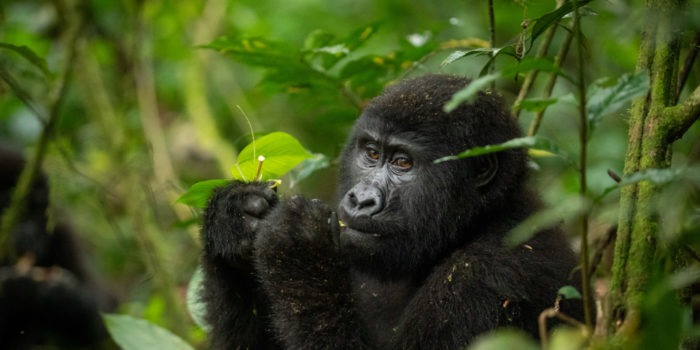
Your heartbeat quickens once again, and then, suddenly, it appears. A 500-pound silverback gorilla has wandered out into a clearing, his gaze now fixed intently on you.
Call it a long-lost connection, call it a meeting of distant cousins, call it whatever you like. Meeting a gorilla family in its natural habitat is an experience that rivals almost anything we humans can encounter.
Safari experiences come in many different forms, and while many will immediately think of East Africa’s open plains and the Big Five, primate trekking offers something entirely different and equally unforgettable.
Primate trekking offers you the opportunity to hike through stunning locations in East Africa and to spend time near humans’ closest relatives. Whether you’re looking to do gorilla trekking or chimpanzee trekking, these are animal encounters that will stay with you for the rest of your life.
While traditional safaris might afford you a comfortable vehicle to sit back in while you search for animals, there is no such luxury when seeking primate species. Primate trekking can be strenuous, sometimes involving walking for up to 6 hours a day in difficult terrain. Is it easy? Certainly not. Is it worth it? Absolutely. That moment when you come face to face with our distant relatives is truly moving and for many, it ranks as the most powerful animal experience they’ve ever had.
The tracking of primates is much more controlled than regular safaris, for the simple reason that there are far fewer animals and their habitat is considerably more inaccessible. Here is where we run primate treks.
Uganda is the only country in Africa where you can track both mountain gorillas and wild chimpanzees on a single trip, and it is the most affordable place to do either.
Gorilla trekking runs in Bwindi Impenetrable National Park and the lesser-known Mgahinga Gorilla National Park, where you may also glimpse rare golden monkeys. Chimpanzee trekking runs in Kibale Forest National Park, Budongo Forest in Murchison Falls, Kyambura Gorge in Queen Elizabeth National Park, and Bwindi itself. All of these forests are also home to the wonderfully bizarre-looking red-tailed monkey.
Read more about Uganda safaris, or see our Uganda chimpanzee trekking page.
Rwanda offers mountain gorilla trekking in Volcanoes National Park, the same Virunga Massif that borders Uganda’s Mgahinga. The draw is the logistics: Kigali is a two-hour drive from the trailhead, so you can arrive in the morning and trek the next day. The lodge scene is the most polished in the region.
The trade-off is cost. A Rwanda gorilla permit is USD 1,500 against USD 800 in Uganda. Read more about Rwanda safaris.
Tanzania is chimpanzee country. We track chimps in the Mahale Mountains National Park, on the shore of Lake Tanganyika, and in Gombe Stream National Park further north.
Mahale is the more remote and more rewarding of the two. There are no roads in, so you arrive by boat or light aircraft, and the forest drops straight down to a beach on one of the deepest lakes in the world. The chimps here are habituated to a level that lets you sit within metres of them.
Read more about Tanzania safaris.
For lowland gorillas, we arrange treks in the Republic of Congo and the Central African Republic. These are true expedition trips into some of the least-visited forest on the continent, and they suit travellers who have already done the classic East African circuit and want something genuinely different. Talk to us about these directly, as logistics vary considerably by season.
Gorillas are the headline experience. You spend one hour with a habituated family, often at close range, and the encounter is quiet, still and deeply affecting. Treks run 2 to 6 hours through steep, wet forest at altitude. Permits are expensive and limited, so dates need to be locked in months ahead.
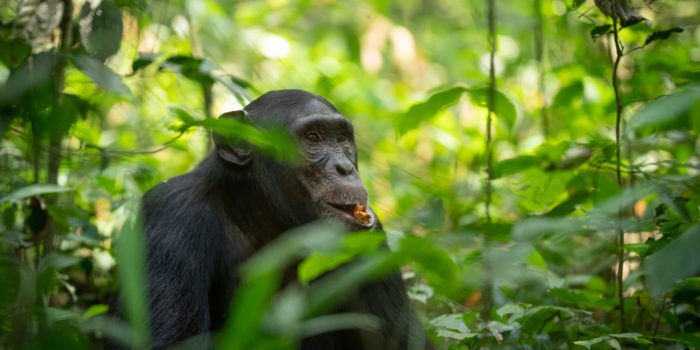
Chimpanzees are the more active experience. Chimps move fast and constantly, so you are tracking rather than sitting. Treks are shorter, permits are far cheaper, and you can combine several forests on one trip. The trade-off is that sightings are more fleeting.
If you can do both, do both. Uganda is the only place where that is straightforward, and we build it into most Uganda itineraries.
| Destination | Permit (USD) |
|---|---|
| Uganda gorilla, Bwindi or Mgahinga | 800 |
| Uganda chimpanzee, Kibale Forest | 250 |
| Uganda chimpanzee, Budongo Forest | 130 |
| Uganda chimpanzee, Kyambura Gorge | 100 |
| Rwanda gorilla, Volcanoes National Park | 1,500 |
| Tanzania chimpanzee, Mahale Mountains | 150 |
| Tanzania chimpanzee, Gombe Stream | 100 |
You will need a permit before getting anywhere near them, and the same goes for chimpanzee tracking. Both should be booked well in advance, as they have become incredibly popular and spaces fill up weeks, even months ahead.
Important: gorilla permits are non-exchangeable and non-refundable, regardless of the weather and how you are feeling in the morning. Treks depart in all weather, rainy season or dry season, without exception. That is worth knowing before you choose your dates, because a permit cannot be moved if it rains on your day.
Uganda permit prices are set by the Uganda Wildlife Authority and reviewed periodically. Foreign residents pay less than non-residents, and East African citizens pay less again. We confirm the current rate for your nationality when we quote.
There is plenty of debate about any human interaction with wild animals and this is particularly true when it comes to primates, as their numbers are far from steady. The mountain gorilla population has seen some dramatic fluctuation over recent years. Jane Goodall, the pioneering primatologist who spent years living and working in Tanzania, did wonders to raise awareness for the collapsing chimpanzee population.
However, it cannot be denied what a crucial role eco-tourism plays when it comes to the conservation of these incredible animals. Your visit to the mountain gorillas of Bwindi Impenetrable Forest essentially preserves the entire wilderness area, which might otherwise be eroded to establish agriculture, e.g. tea plantations. Eco-tourism creates employment for the locals and teaches them the worth of their natural heritage and the wild animals they share space with.
Chimpanzees and gorillas are both on the endangered list and because of this, interaction with them anywhere in Africa is tightly controlled. Time spent with both is limited to just one hour, with physical interactions completely off the table, unless they make first contact. This system may sound incredibly short and un-interactive, but to help maintain their way of life, it’s imperative.
With these guidelines in place, both Uganda and Tanzania have managed to create an ethical method of seeing both gorillas and chimpanzees, that protects their natural way of life against excessive human interaction. What’s more, permit fees taken from tourists form the backbone of the fight against poaching, which continues to damage primate populations across Africa.
Apart from your permits, it’s important to be prepared. This is no walk in the park, and treks can be strenuous and often in difficult environments. You must come prepared for the terrain, which means good quality hiking boots, waterproofs, sun cream, insect repellent, plenty of water and a packed lunch.
We recommend a decent level of fitness and coming with no infectious diseases that might be passed on to the primates. If you are showing signs of a cold or flu, you may well be denied participation. As frustrating as this might seem, it’s pretty clear why this rule is in place.
One rule that could make or break your wish to go primate trekking is the age limit. Gorilla trekking is restricted to those aged 15 and over. Chimpanzee trekking age limits vary by park and country, so check with us before you book. As great as it would be for your children to see primates in their natural world, the difficulties with terrain, as well as the need for restrained behaviour while around them, mean this is largely an adults-only excursion.
Whether you’re looking to combine a primate trek with a more traditional safari or simply focus on our ancestral cousins, there is no experience quite like it anywhere in the world.
The Bwindi Impenetrable National Park, the Kibale National Park, the Queen Elizabeth National Park and the Murchison Falls National Park in Uganda all offer not only a wide range of animals, both primate and otherwise, their forests and thick vegetation offer some sublime walking experiences that will certainly leave you feeling like you’ve seen the heart of Africa.
In Tanzania, the Mahale Mountains National Park, sitting beside the twinkling Lake Tanganyika, is the perfect location to spend some time and is just a short plane ride to Tanzania’s big-hitting locations further north.
Witnessing primates in the wild, and particular mountain gorillas is a once in a lifetime experience and one which is firmly planted on many a bucket list. East Africa is the place for a primate experience and once you’ve come face to face with a gorilla family in a tropical forest, watched the young play unsteadily just like human children, while the parents dote lovely on the juveniles, the unseen connection between human and primate suddenly becomes so much clearer and all the more powerful.
They are different experiences rather than better or worse. Gorilla trekking is quieter and more intimate, with a guaranteed hour at close range. Chimpanzee trekking is more active, since you are following a fast-moving group through the forest. Most travellers who do both say the gorillas stay with them longer, but the chimps are more fun.
A Uganda gorilla permit is USD 800 per person per trek for foreign non-residents. A Rwanda permit is USD 1,500. On top of that you need park fees, accommodation, transport and, in most cases, a domestic flight. A 3-night gorilla trekking trip in Uganda typically starts around USD 3,000 per person excluding international flights.
Uganda. At USD 800 per permit it is roughly half the Rwanda price, and Bwindi holds about half the world’s mountain gorillas. Uganda also lets you add chimpanzees, savanna parks and the source of the Nile to the same trip, which Rwanda cannot match.
Yes, and Uganda is the only country where this is straightforward. Most travellers fly into Entebbe, trek chimpanzees in Kibale Forest, then drive south to Bwindi for gorillas. We usually allow 5 to 7 nights for both.
As early as you can. Bwindi has about 22 habituated families across four sectors, and the dry season months of June to August and December to February sell out months ahead. For peak dates, six to twelve months is not too early.
Reasonably fit. Gorilla treks can run 2 to 6 hours through steep, wet forest at altitude, and Bwindi sits between 1,160 and 2,600 metres. Chimpanzee treks are usually shorter but faster. Porters are available in Uganda and are worth every dollar.
Contact SAFARI FRANK to get started on your safari of a lifetime!