Why we like it
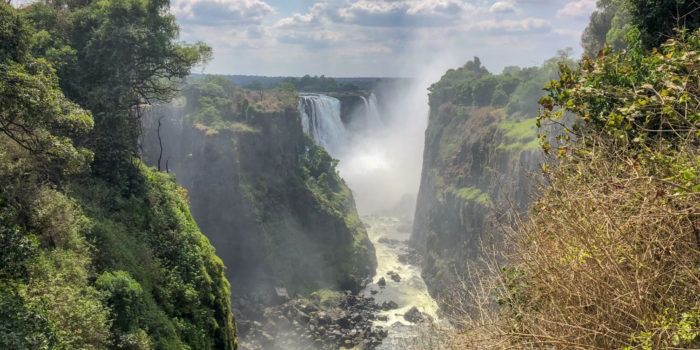
- The largest curtain of falling water in the world at 1,708 metres wide and 108 metres high, and a UNESCO World Heritage Site since 1989.
- One of the few places on earth where you can swim at the lip of a waterfall, at Devil’s Pool on the Zambian side.
- The adventure capital of Africa, with white water rafting, bungee jumping, gorge swings, microlights and helicopter flights.
- The Zimbabwe side has around two thirds of the Falls frontage and about 16 viewpoints along a 1.7 km rainforest trail.
- Easy to reach, with an international airport twenty minutes from town and daily flights from Johannesburg.
- The perfect place to end a safari, and an easy add-on to Hwange, Chobe or the Okavango.
- The KAZA UniVisa lets you cross between Zimbabwe and Zambia freely for 30 days.
Victoria Falls is the one place in Zimbabwe we recommend to almost everyone, because it works as an ending to any safari and it takes almost no effort to get to. The town is a twenty minute drive from the airport and you can be standing at the viewpoints the same afternoon. Our honest advice is to stay on the Zimbabwe side, because that is where two thirds of the Falls frontage and the best viewpoints are, then cross to Zambia for a day if you want Devil’s Pool or a microlight. Two nights is enough for most people. Three if you want to do the rafting as well.

What is Victoria Falls?
Victoria Falls is a waterfall on the Zambezi River, on the border between Zimbabwe and Zambia in southern Africa. It is 1,708 metres wide and 108 metres high, which makes it the largest single curtain of falling water in the world. The local name is Mosi-oa-Tunya, meaning “the smoke that thunders”, and the spray can be seen from kilometres away. UNESCO inscribed it as a World Heritage Site in 1989.
Which side of Victoria Falls should I stay on?
Stay on the Zimbabwe side. It has roughly two thirds of the Falls frontage and about 16 viewpoints along a well maintained 1.7 km rainforest trail, so you see more of the waterfall and you see it better. The Zambian side gets you closer to the edge and is home to Devil’s Pool, the microlights and the Knife-Edge Bridge, but it is quieter and the falls there can dry up almost completely in the low season. Most travellers stay in Zimbabwe and cross to Zambia for a day. The KAZA UniVisa makes that easy.
When is the best time to visit Victoria Falls?
June to October is the best time to visit Victoria Falls for a combination of water flow, clear views and activity access. The river peaks between April and May, when the Falls is a thundering wall of water, but the spray can be so heavy that you cannot see much from the viewpoints. By September and October the flow drops, the spray clears and you can see the full structure of the gorge. Devil’s Pool opens in the low water months, roughly mid-August to December.
| Period | Water level | Conditions | Verdict |
|---|---|---|---|
| January to March | Rising | Hot and humid, heavy spray | Dramatic but views often obscured |
| April to May | Peak flood | Maximum power, heaviest spray | Spectacular. Bring a raincoat |
| June to August | High, falling | Clear days, spray easing | Best all-round. Ideal conditions |
| September to October | Low | Spray minimal, gorge fully visible | Best views. Devil’s Pool open |
| November to December | Lowest | Hot, dry, some viewpoints dry | Devil’s Pool open. Zambian side thin |
What can you do at Victoria Falls?
White water rafting is the headline, running the Zambezi rapids below the Falls, and it is at its wildest in the low water months. Bungee jumping and the gorge swing operate from the Victoria Falls Bridge. Helicopter and microlight flights give you the aerial view that solves the spray problem, and the microlights operate from the Zambian side. Sunset cruises on the Zambezi above the Falls are the quiet option and suit anyone who does not want adrenaline. Devil’s Pool, on Livingstone Island on the Zambian side, lets you swim in a natural rock pool at the lip of the Falls, and it is only open in the low water season. On the Zimbabwe side, the rainforest trail and the viewpoints are the main event, and they take two to three hours at an easy pace.
How do you get to Victoria Falls?
Victoria Falls has its own international airport, about twenty minutes from the town centre, with daily flights from Johannesburg, Cape Town, Nairobi and Addis Ababa, plus direct connections to Harare and Bulawayo. It is also an easy road transfer from Hwange National Park, roughly two hours, and from Chobe in Botswana, about an hour and a half to the Kazungula border. Most travellers fly in, spend two or three nights, and either fly home or continue to a safari camp. We usually pair Victoria Falls with Hwange, and often with Mana Pools or the Okavango Delta.
Do I need a visa for Victoria Falls?
Most nationalities need a visa for Zimbabwe, and a separate one for Zambia if you plan to cross. The simplest option is the KAZA UniVisa, which costs around USD 50 and allows unlimited crossings between Zimbabwe and Zambia for 30 days, plus day trips to Botswana through the Kazungula border. It is available on arrival at Victoria Falls airport and at the land borders, though eligibility depends on your nationality. Check your specific requirements before you travel, because the rules change.
Seasonal timings for activities

| jan | feb | mar | apr | may | jun | jul | aug | sep | oct | nov | dec |
 | | |  | |  | | | | | | |
= Best
= Good
= Mixed


Safaris
Victoria Falls





Places to stay
Related Accommodation


Adventures in Victoria Falls

Varied Adventures of Victoria Falls
Read more
Ready for an adventure? Lets Talk!
Contact SAFARI FRANK to get started on your safari of a lifetime!