The course takes place in two (sometimes three) of our wilderness camps, so you get to know different landscapes, wildlife and ecosystems. The camps are remote, deep in the wilderness. You share a tent with one other participant; men and women do not share a tent unless booked as a couple.
Price
8,150 USD
* (See price tab)
Course Type
Professional
Country
Botswana, South Africa
Duration
54 Nights
Location
Makuleke Concession Pafuri, Timbavati & Klaserie Nature Reserves
The Field Guide Course is the classic way to become a safari guide in South Africa: 55 days in the bush, in at least two wilderness camps, with the FGASA assessment at the end. You can qualify as an FGASA Nature Site Guide (NQF2) and then work as a field guide on game drives. In 2027 the course costs ZAR 143,100 per person, including accommodation and meals.
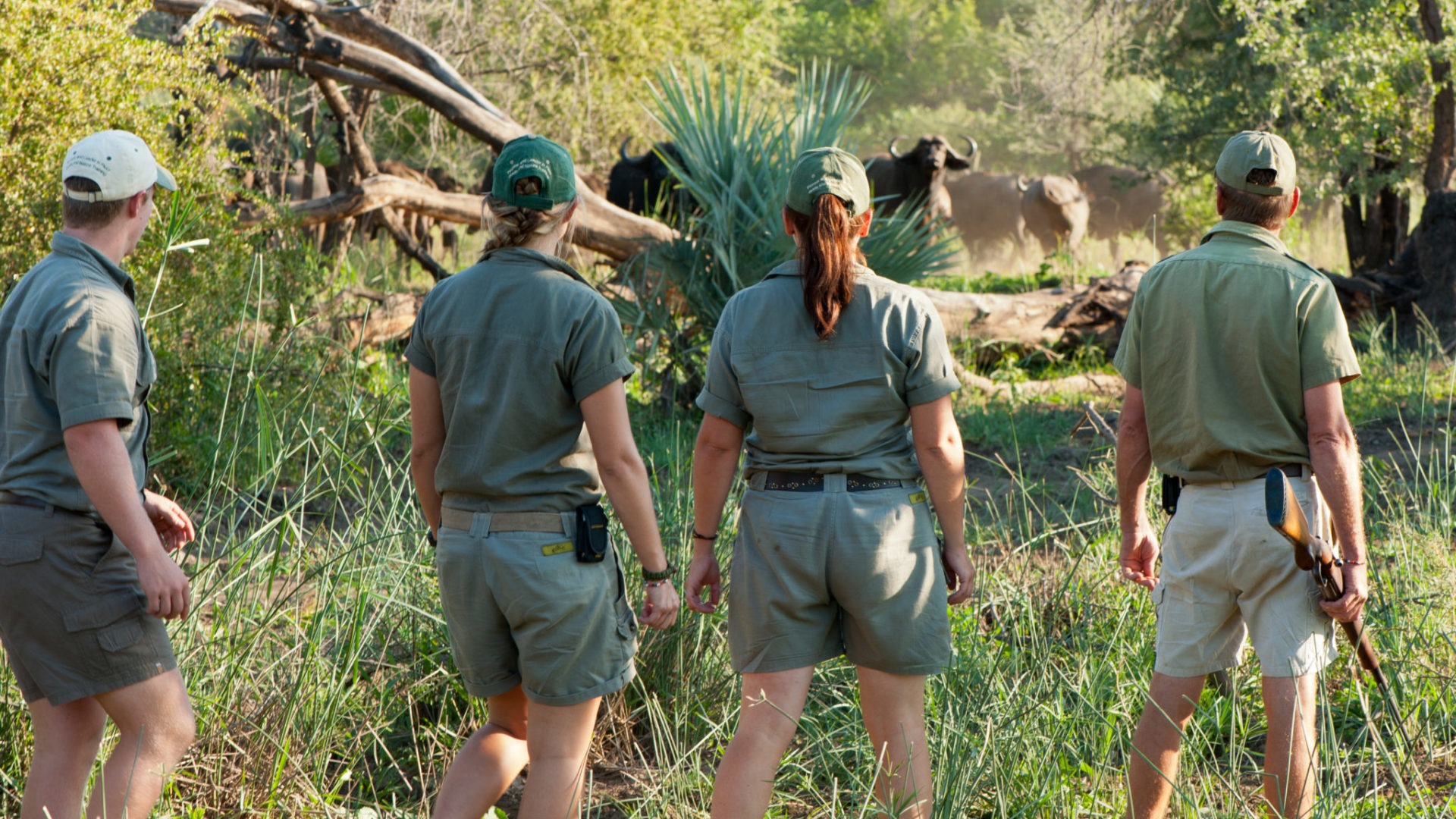
Do you want to work as a guide or in another wildlife career? This course is the first step. It is endorsed by FGASA (Field Guide Association of Southern Africa) and accredited by CATHSSETA. You learn outdoors every day: on game drives, bush walks and in lectures at camp.
general information
Who is the course for?
The course lays the foundation for a career as a field guide and for many other conservation jobs. Many participants also take it as a gap year, a sabbatical or an extended bush holiday. The assessment is optional: if you simply want to learn, you receive a letter of participation.
A typical day at camp
The day starts early with coffee, tea and fruit, followed by a game drive or bush walk. After brunch there are lectures about the morning’s sightings, then time to study or rest. The second activity starts in the afternoon, and the day ends with a warm dinner at camp.
Requirements
- Minimum age 18
- Good spoken and written English (lectures and assessments are in English)
- Valid driver’s licence, preferably for a manual car
- Valid first aid certificate (before or after the course, from any accredited provider in any country)
- Basic fitness: able to walk at least 2 km
Frequently asked questions
How long does it take to become a field guide in South Africa? The Field Guide Course takes 55 days. You can then continue with specialist courses such as the 28-day Trails Guide Course, or choose the one-year Professional Field Guide Course for the full path to a professional guide.
How much does the field guide course cost? In 2027 the course costs ZAR 143,100 per person. Accommodation, meals, training and all FGASA assessment fees are included; travel, transfers to camp and drinks are extra.
What qualification do I get? If you pass the assessments, you qualify as an FGASA Nature Site Guide (NQF2), often called “FGASA Level 1”, and receive the EcoTraining Field Guide Certificate. Without the assessments you receive a letter of participation.
Do I need any previous experience? No. You need good English, a driver’s licence and a first aid certificate, and you must be at least 18. Everything else you learn on the course.
Can I work as a field guide after the course? The FGASA qualification allows you to guide guests on game drives in South Africa. Most lodges also require a Professional Driving Permit (PrDP), which is not available to under-21s or foreigners without a study visa.
Is the course worth it without a career goal? Yes. Many participants take it as a gap year, a sabbatical or an intensive bush experience. The assessment is optional.
Still have questions? You’ll find answers on travel, visas, packing and everyday course life in our Field Guide Training FAQ.
about the school
EcoTraining: field guide training in Africa since 1993
Our partner EcoTraining has been training safari guides, field guides and wildlife professionals since 1993 and is a pioneer of guide training in Africa. Its courses are known in the safari industry for their high standards and credibility.
EcoTraining is an FGASA-registered and endorsed training provider and is accredited by CATHSSETA, which makes this course a recognised field guide qualification in South Africa. The instructors are experienced guides and FGASA-endorsed assessors who run the assessments at camp.
All courses take place in EcoTraining’s own unfenced bush camps in some of the most pristine wilderness areas of South Africa, Botswana and Kenya. Besides career courses like this one, EcoTraining offers nature courses, specialist courses, gap year and sabbatical programmes, and on-site training for guides at safari lodges. Thousands of people from 33 countries have trained with EcoTraining.
course content
The course covers everything a field guide needs for game drives:
- Introduction to guiding and creating a guided nature experience
- Geology, weather and climate, astronomy
- Basic ecology and the biomes of southern Africa
- Botany and grasses
- Mammals, birds, reptiles, amphibians, fish and arthropods
- Animal behaviour, including tracks
- Basic taxonomy
- Conservation management and historical human habitation
- A 1–2 night wilderness sleep-out
Tip: EcoTraining recommends the e-book “Your Guide to Guide” for preparation.
start dates
No suitable date? See all our field guide course dates at a glance.
5 January 2027 - 28 February 2027
14 February 2027 - 9 April 2027
17 March 2027 - 10 May 2027
12 April 2027 - 5 June 2027
12 June 2027 - 5 August 2027
10 July 2027 - 2 September 2027
6 August 2027 - 29 September 2027
9 September 2027 - 2 November 2027
18 October 2027 - 11 December 2027


transfers
Scheduled Bush Bus transfers
There is one scheduled transfer at the start and one at the end of every EcoTraining course. These transfers are not included in the course price.
Departure from Johannesburg (first day of the course)
All scheduled EcoTraining bus transfers leave from the Emerald Guesthouse on the first day of the course. Departure is at 7 am sharp, so please arrive at least 15 minutes beforehand.
If you are flying into Johannesburg (internationally or domestically), please arrive the day before and stay overnight at the Emerald Guesthouse. This makes sure everyone is there on time and the bus can leave as planned. Please book directly with the Emerald Guesthouse at [email protected].
The guesthouse is close to OR Tambo International Airport and will pick you up free of charge if you send them your flight details. It offers a range of rooms to suit different needs and budgets. As the bus leaves early in the morning, staying at the guesthouse the night before makes your departure much easier.
Travel time (to/from the EcoTraining camps):
- Pridelands, Timbavati or Karongwe: approx. 5 hours
- Botswana: approx. 7 hours
- Makuleke Concession (Kruger National Park): approx. 7 hours
Departure from camp (last day of the course)
All scheduled EcoTraining bus transfers leave the camp on the last day of the course. Departure is at 8 am sharp from all camps.
You will arrive in Johannesburg in the late afternoon. Drop-off is only possible at OR Tambo International Airport or the Emerald Guesthouse. Please book a late evening flight (ideally 8 pm or later), or stay another night at the Emerald Guesthouse after the course.
qualifications
If you pass the theory and practical assessments, you receive:
- FGASA Nature Site Guide (NQF2) – the recognised entry-level qualification for field guides in South Africa (often called “FGASA Level 1”)
- EcoTraining Field Guide Certificate (Nature Site Guide NQF2, CATHSSETA)
EcoTraining registers you with FGASA and CATHSSETA, so you don’t need to do this yourself. If you choose not to take the assessments, you receive a letter of participation. FGASA only issues your certificate once you hold a valid first aid certificate.
After this course you can continue with the Trails Guide Course and specialise in walking safaris.
price
Price 2027
ZAR 143,100 per person (sharing a tent; single tent +30%)
Included
- Accommodation and all meals, tea, coffee and cordials
- Instructors and training
- Game drives and walks
- Transfers between the course camps
- All FGASA registration, examination and moderation fees, training manuals and workbooks
- Other activities such as the wilderness sleep-out
- New in 2027: branded uniform (1 cap, 2 collared shirts)
Not included
- Flights and airport taxes
- Insurance
- Accommodation before and after the course
- Transfers to and from camp
- Drinks (beer, cider, soft drinks) and laundry
- Kruger National Park entry (Makuleke courses) or Botswana border crossing
- NDT registration (formerly DEAT)


Do you want to become a safari guide?
Send us a message and we will help you find the right course and start date.